
The Best Centers for Treating Keratoconus with Laser in Egypt and the Arab World
Dr. Mohamed El Naggar relies on accurate and advanced examinations to evaluate the shape of the cornea and measure the degree of progression of the condition, which helps in choosing the most appropriate therapeutic procedure for each patient, whether corneal cross-linking, therapeutic contact lenses, or corneal transplantation in advanced cases.
Has the quality of your vision noticeably deteriorated recently? And has your doctor told you that you are not eligible for laser vision correction surgery? If you answered yes, the situation is not that bad. On the contrary, there is an opportunity to undergo a modern, advanced, and safe treatment that in many cases surpasses laser procedures, namely the procedure of lens implantation for vision correction, which works to improve the quality of vision, focusing, and daily tasks. It is available at Dr. Mohamed El Naggar Center with the latest and most effective types of lenses. The types of these lenses, their characteristics, and the differences between them will be discussed in this comprehensive guide. We wish you an enjoyable reading.
Choosing the appropriate doctor is one of the most important factors in the success of keratoconus treatment and maintaining vision stability in the long term, especially since every case requires accurate evaluation and determining the appropriate treatment plan according to the stage of the disease and the degree of its effect on vision. Dr. Mohamed El Naggar is distinguished by specialized experience in diagnosing and treating corneal diseases using the latest modern medical technologies.
Keratoconus disease is known as one of the most important progressive diseases that appear during youth and cause difficulty in vision and countless visual problems, which are often not treatable with prescription glasses and traditional methods. Therefore, the treatment of keratoconus differs from all other treatments for eye diseases, as it depends on correcting the shape of the cornea and morphological correction until excellent visual results are reached. This represents a summary of the treatment plan at Dr. Mohamed El Naggar Center for those suffering from keratoconus, where they are treated with an integrated plan from all aspects. Let us learn about it in this detailed guide. We wish you an enjoyable reading.
What Is Keratoconus Disease?
Keratoconus disease is known as a progressive disease that affects the external part of the eye, specifically the corneal layer, which represents a highly transparent layer located on the front surface of the eye, touching the outside air externally and the iris of the eye internally.
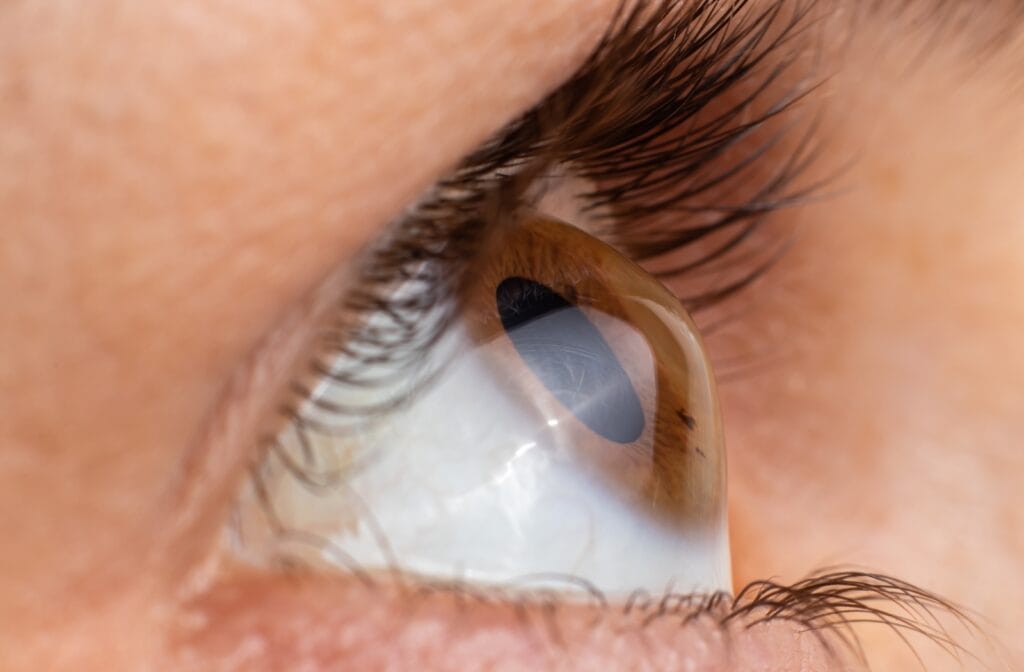
In this pathological problem, a change occurs in the shape of this cornea from the regular lens-like shape to the conical shape.
The Pathological Mechanism of Developing Keratoconus
Before learning about the treatment of keratoconus and other details, it should be noted that the mechanism of occurrence of this disease is somewhat complex.
In the first degree, the pathological morphological change in the cornea occurs as a result of weakness of its internal tissues.
This weakness may occur as a result of an imbalance of enzymes in the corneal layers. Consequently, these layers are exposed to the risk of oxidative damage and become vulnerable to attack by free-radical compounds that cause fragility of the corneal layers and consequently change their shape.
The Shape of Keratoconus
The patient cannot be completely certain that they have keratoconus at the beginning of the disease, because the symptoms of this disease are very slow and may take many years to appear clearly.
However, sometimes the patient suddenly discovers severe weakness in vision, and when looking sideways at the mirror, notices that the external layer of the eye protrudes forward in the shape of a triangle or a peak.
This often indicates the presence of keratoconus at a relatively advanced stage.
When interpreting this condition, we find that the forward protrusion of the cornea is the reason for the scattering of light rays when they enter the eye and the lack of clarity of vision.
This condition can appear at all age stages, but the condition may be more severe in one eye than the other.
Keratoconus may also affect children and may be hereditary in origin, while it appears in some patients approximately ten years after the onset of the condition.
Therefore, it was said that Dr. Mohamed El Naggar takes corneal treatment procedures after verifying all the details of the condition in order to treat the eye completely.
Symptoms and Signs of Keratoconus
In the mild degrees of keratoconus, the patient may not notice any change in their degree of vision.
However, since this disease is progressive, it will continue to develop, and therefore the symptoms of the condition will appear gradually and will be as follows:
- Myopia or other refractive errors.
- Irregularity of the corneal surface, meaning astigmatism.
- Noticeable distortion of vision.
- Seeing annoying glare.
- Severe light sensitivity.
- Vision does not improve when wearing prescription glasses.
Causes of Keratoconus in the Eye
The main cause of keratoconus in the eye is a decrease in the level of antioxidants in the eye or incorrect behaviors that affect eye health. These factors can be summarized as follows:
- Long and direct exposure to sunlight without any means of protection, and therefore receiving a large amount of harmful ultraviolet radiation.
- Continuous rubbing of the eyes, especially in cases of allergies that stimulate this behavior, and consequently affecting the shape of the cornea.
- Wearing contact lenses incorrectly for many years or not taking sufficient care of them.
- Chronic eye inflammations that have been ignored or whose treatment has been delayed until advanced stages.
How Is Keratoconus Diagnosed?
The most appropriate keratoconus treatment technique is selected for each patient based on different diagnostic examinations and various tests that evaluate eye health and ensure excellent visual results. The most important of these diagnostic tests include:
- Refraction Test: It measures the ability of the eye to refract light rays correctly through the layers of the cornea responsible for this.
- Measurement of Corneal Thickness: In many cases, keratoconus is accompanied by a decrease in corneal thickness as a result of its forward protrusion.
- Determining the Degree of Corneal Curvature: This is a very important factor in determining the degree of keratoconus and the most appropriate treatment method.
- Slit-Lamp Examination: This is performed using a specialized microscopic lamp directed toward the cornea to determine the reflection resulting from it.
- Corneal Imaging: In order to determine the points of corneal damage and the extent of irregularity of the external surface.
Methods of Treating Keratoconus in the Eye
The techniques for treating keratoconus in the eye are almost unified at Dr. Mohamed El Naggar Center and all medical centers around the world, but the development of the devices and equipment used, the simplicity of completing the therapeutic procedures, in addition to the high medical efficiency, are what make the difference in the results of the procedure, the speed of recovery, and the final stability of vision quality.
There are different methods for treating keratoconus, the most important of which are:
Corneal Cross-Linking for Keratoconus with Riboflavin
This keratoconus treatment technique is called corneal collagen cross-linking. It is a therapeutic technique that depends on strengthening the corneal tissues and stopping the corneal surface from protruding forward over time.
In this procedure, the cross-links that work to connect the collagen fibers to each other in the cornea are targeted by increasing the number of these cross-links.
This therapeutic technique ultimately works to significantly reduce the progression of keratoconus while reducing the need for corneal transplantation surgery in the future, in addition to treating all the symptoms associated with this disease.
In severe cases, this technique can be combined with the technique of lens implantation or corneal ring implantation in order to achieve excellent synergistic results.
There are two different methods of performing corneal cross-linking as follows:
The Method of Corneal Cross-Linking While Preserving the Epithelial Layer
In this therapeutic technique, the external epithelial layer of the cornea is not approached. The riboflavin solution is applied to the surface of the eye and left for a longer period compared with the other method in order to ensure that the substance reaches all layers of the cornea, and then ultraviolet radiation is used. This method ensures a reduced risk of infection to the minimum, rapid recovery, and less pain.
The Method of Corneal Cross-Linking by Removing the Epithelial Layer
In this method, a surgical scraper, laser radiation, or even an alcoholic solution is used to remove the superficial layer of the cornea, which is called the epithelial layer. This allows the riboflavin substance to enter all layers of the cornea easily within a short period, and then this substance is activated by ultraviolet radiation directed directly at it.
Specialized Therapeutic Contact Lenses for Keratoconus
Recently, new contact lenses have been introduced specifically for patients suffering from keratoconus. These lenses are very thin and suitable for correcting mild and moderate corneal problems.
These lenses are manufactured according to order, where individual lenses are manufactured for each patient according to their eye measurements.
These lenses can be a very comfortable therapeutic option compared with gas-permeable therapeutic lenses and hybrid lenses that have recently become well known.
These lenses also have a relatively large diameter that helps them remain stable comfortably and firmly on the surface of the cornea.
There are also gas-permeable contact lenses, which are considered among the best methods of treating keratoconus. They stabilize on the irregular cornea and are characterized by a regular, smooth, reflective surface capable of improving vision well.
However, many patients cannot easily get accustomed to this type of lens, and it sometimes requires a long time for them, with repeated visits to the ophthalmologist until the measurements of the optical lenses are adjusted perfectly.
Corneal Ring Implantation
One of the most important advanced procedures for treating keratoconus, in which medical rings are implanted inside the eye that work to correct the shape of the keratoconic cornea in its moderate degrees.
One or two rings are manufactured in a circular shape from biological materials compatible with the eye tissues, designed to remain in the eye for very long years. These rings are implanted in the middle layers of the cornea.
They work in this way to reduce the degrees of severe curvature in keratoconus and flatten the protruding surface as much as possible, and consequently correct vision well.
It should be noted that the keratoconus corneal ring implantation procedure is the synonymous name for the keratoconus treatment with laser procedure. This is because this procedure uses laser rays to make precise incisions in the middle layers of the cornea in order to implant the rings in them.
Thus, we conclude that the laser used is the femtosecond laser, but traditional laser procedures have no relation to correcting keratoconus in the end.
The ring implantation procedure can also be adopted to correct refractive vision problems, and prescription glasses may be used at the same time to achieve excellent results.
Treatment of Keratoconus with Laser
There is no such thing as treatment of keratoconus with laser, and this idea is completely incorrect because laser rays are not suitable at all for the condition of the cornea.
This is because laser techniques themselves work to correct the external shape of the cornea by removing some tissues from different points in the cornea.
When we are dealing with a keratoconic cornea, the layers are very thin and on the verge of damage, protruding forward and weak, and cannot tolerate any additional pressure.
If laser is applied to it, it will cause tearing or ulceration in the corneal layers, in addition to significantly increasing the degree of astigmatism, which the laser cannot treat.
Nevertheless, there is one therapeutic method in which laser is used to treat keratoconus. This method is called the Athens Protocol, in which traditional laser or surface laser that depends on the eye fingerprint is used to reshape the surface of the cornea as much as possible, followed by performing corneal cross-linking with riboflavin after a period of time.
This protocol aims to improve the quality of vision and prevent its deterioration later.
Corneal Transplantation Surgery
One of the most important methods of treating keratoconus in very severe degrees that do not respond to corneal cross-linking, ring implantation, or even contact lenses, because the cornea has become damaged and is completely unable to perform its function correctly.
There are several types of corneal transplantation surgery, including total corneal transplantation, partial transplantation, or endothelial transplantation. Each has a specific therapeutic technique and a different success rate.
In general, however, this surgery can be considered one of the excellent procedures that ensures high success rates exceeding 90%, due to its high precision and excellent visual results.
It can also be said that performing this operation is not difficult, because there are thousands of corneal donors around the world every year, where the cornea is obtained from a recently deceased donor whose tissues match the patient’s tissues completely.
Dr. Mohamed El Naggar relies on corneal banks in the United States of America and the European continent, as they are among the best sources for obtaining high-quality human corneas.
Is Keratoconus Dangerous?
Fear of treating keratoconus does not justify delaying treatment of this disease at all.
Although keratoconus is a disease that should not be underestimated in the eye, it is not extremely dangerous unless treatment of the disease is delayed until the eye deteriorates completely.
In advanced cases of keratoconus, the patient may notice severe weakness in vision and a sudden change in it, in addition to visual problems that affect the patient’s daily life.
Many patients also ask: Does keratoconus cause blindness? Here we can say that this disease does not reach this stage. It is relatively dangerous, but it does not lead to complete, untreatable loss of vision. However, it causes severe deterioration in vision that is treated through keratoconus treatment.
What Is the Appropriate Age to Undergo Keratoconus Surgery?
Treatment of keratoconus can be performed at any age, generally immediately after the disease is diagnosed.
For example, we find that corneal cross-linking can be performed from the age of 14 years.
While corneal transplantation surgery is preferably performed after reaching the age of 18.
Nevertheless, these therapeutic procedures can be adopted for young people, children, and elderly people from the time the condition is discovered.
The Best Keratoconus Doctor in Egypt
Treating keratoconus with high precision and excellent visual results is only available at Dr. Mohamed El Naggar Center, the best keratoconus doctor in Egypt.
Dr. Mohamed El Naggar is a Professor of Ophthalmology and Eye Surgery, and has been outstanding for several years in the field of eye surgery in Egypt, with a history full of achievements and successes in treating keratoconus problems.
Dr. Mohamed El Naggar specialized in corneal surgeries, cataract surgery, lens implantation, and vision correction.
From the medical aspect, we find that Dr. Mohamed El Naggar’s experience is exceptional and unparalleled in terms of consultations, medical diagnosis, or even advanced treatments. He has dealt with the most difficult eye diseases and deteriorating problems that most doctors had given up on treating.
From the professional aspect, Dr. Mohamed El Naggar established his distinguished medical center specializing in corneal surgeries, cataract surgery, and treatment of refractive vision problems. He has worked with many organizations, including the European Society of Cataract Surgery and Refractive Vision Problems.
He also joined the Royal College of Ophthalmic Surgeons in Edinburgh, and became a member of the International Council of Eye Surgery in Switzerland and other international medical institutions.
He also established a distinguished medical center called Al-Jazira Al-Arab Eye and LASIK Center in his homeland, beloved Egypt.
At 24 Al-Gezira Al-Arab Street, Mohandessin – Al-Hegaz Street, Al-Safa Medical Tower, Mohandessin – 437 North Teseen Street, Fifth Settlement, Dr. Mohamed El Naggar Center is located. The center has treated thousands of difficult medical cases and restored natural vision to tens of thousands of patients over many years.
Therefore, keratoconus treatment there is performed using the latest technologies and the best medical equipment that ensure accurate diagnosis and completely correct treatment for every patient suffering from keratoconus that affects daily life. However, its final treatment is simpler than any patient may imagine when under the supervision of a capable doctor and through the appropriate method.